Email vs SMS for Abandoned Cart Recovery: Which is better for your small Shopify store?
Short answer: SMS outperforms email on almost every metric that matters for cart recovery. But the best strategy doesn't pick one. It uses both, in the right order, at the right time.
If you only have time to set up one channel, set up SMS. The numbers aren't close. But if you stop there, you're leaving the easiest 5 to 10 percent of recovered revenue on the table.
Here's the full breakdown.
Head-to-Head Comparison: Email vs SMS
Metric | SMS | |
|---|---|---|
Open rate | 20% (industry avg) | 98% |
Time to open | 6+ hours (often 24+) | Under 3 minutes |
Click-through rate | 2 to 3% | 19 to 26% |
Cost per message | Less than $0.001 | $0.01 to $0.03 |
Cart recovery rate | 8 to 10% | 18 to 25% |
Character limit | Unlimited | 160 (per segment) |
Visuals | Full HTML, images, video | Plain text plus 1 link |
Spam risk | High (Promotions tab) | Very low |
Setup complexity | Higher (templates, design) | Lower (short copy) |
The two numbers that matter most for cart recovery are open rate and time to open. SMS wins both by a wide margin. A cart abandoned at 2pm is a recovery opportunity that decays fast. By 6pm it's mostly gone. By the next morning it's almost always gone.
Email simply can't move that fast. Even if your customer opens email on their phone, they're not opening it within three minutes of receiving it. Most don't open it the same day when and if they open their eMail app.
When Email Works Better
Email isn't dead. There are real situations where it's the right tool.
1. Long-form content and storytelling. If you sell a considered purchase (skincare with a 30-day routine, supplements, fitness gear), an email that walks through ingredients, before/after photos, and customer reviews is more persuasive than any text message could be. SMS forces brevity. Email lets you sell. Sophisticated templates with bright colors that conform to your brand aesthetic is something you'd want to put in an email.
2. Visual product showcases. Fashion, home decor, jewelry, art, anything where the buyer wants to see the product from multiple angles. SMS can include one image via MMS, but the experience is rough. Email is built for this.
3. Nurture sequences. A 5-email welcome series for new subscribers. A 10-email post-purchase sequence. These exist to build a relationship over weeks, and SMS would feel invasive. Email is the right channel for slow, cumulative trust.
4. Cost at scale. Once you're sending hundreds of thousands of messages a month, the per-message economics start to matter. Email costs fractions of a cent. SMS costs 1 to 3 cents per message. For top-of-funnel content where open rates aren't critical, email is the better dollar.
For most stores under $1M in annual revenue, none of the cost stuff matters yet. SMS volume will be small. The question is which channel converts the cart in front of you right now, and that's where SMS wins.
When SMS Works Better
1. The 30-minute recovery window. Cart abandonment recovery rates drop fast after the first hour. A text message hits the customer's phone within 3 minutes of being sent and gets read. An email might sit unopened for a day. If you only get one shot at the cart, SMS is the shot. Where eMail is to storytell and build a brand, SMS is to close the sale (when done right).
2. High-value carts. When a $200 cart abandons, every minute of delay costs you. SMS gives you the fastest possible response. Even a small lift in recovery rate on a high-AOV cart pays for SMS many times over.
3. Mobile-first audiences. If your store skews Gen Z or millennial, your shoppers live on their phones and ignore email. The Promotions tab is where their cart recovery emails go to die. SMS lands directly in the same inbox they use to text their friends.
4. Time-sensitive offers. Flash sales, limited stock, abandoned cart discounts that expire in 24 hours. Urgency requires speed. Email arrives too late for urgency to work.
5. Direct response products. Impulse buys, limited drops, novelty items, anything where the buying decision is fast and emotional. SMS matches the energy. A long email gives the shopper time to talk themselves out of it.
Why Shopify's Built-in Cart Emails Aren't Enough
This is worth its own section because most Shopify owners assume the built-in abandoned cart email is doing the job. It isn't.
Problem 1: The 1-hour minimum delay. Shopify's native cart recovery email can't be sent any sooner than 1 hour after abandonment. By that point, recovery rates are already cut roughly in half compared to a 30-minute send.
Problem 2: Low open rates. Shopify's default templates aren't optimized for deliverability or copy. Most go straight to the Promotions tab in Gmail, which is where promotional emails go to be ignored. Open rates on these defaults often sit below 15 percent.
Problem 3: Generic templates. The default email is plain, branded with your logo, and that's about it. No personalization, no urgency, no real reason for the shopper to come back beyond a single button.
Problem 4: No SMS option. Shopify's built-in flow is email-only. If you want SMS recovery, you need a separate app such as matrucart.
Problem 5: One-and-done. The native flow sends one email. That's it. No follow-up sequence, no second touch, no escalating urgency. If the first email misses, the cart is gone.
If you're relying on the default Shopify cart email, your recovery rate is almost certainly under 5 percent. A real recovery setup, even a basic one, should be doing 4 to 5x that.
The Best Strategy: Email Plus SMS, in Sequence
Here's the play that actually wins. Both channels, layered together, with timing that matches how shoppers behave.
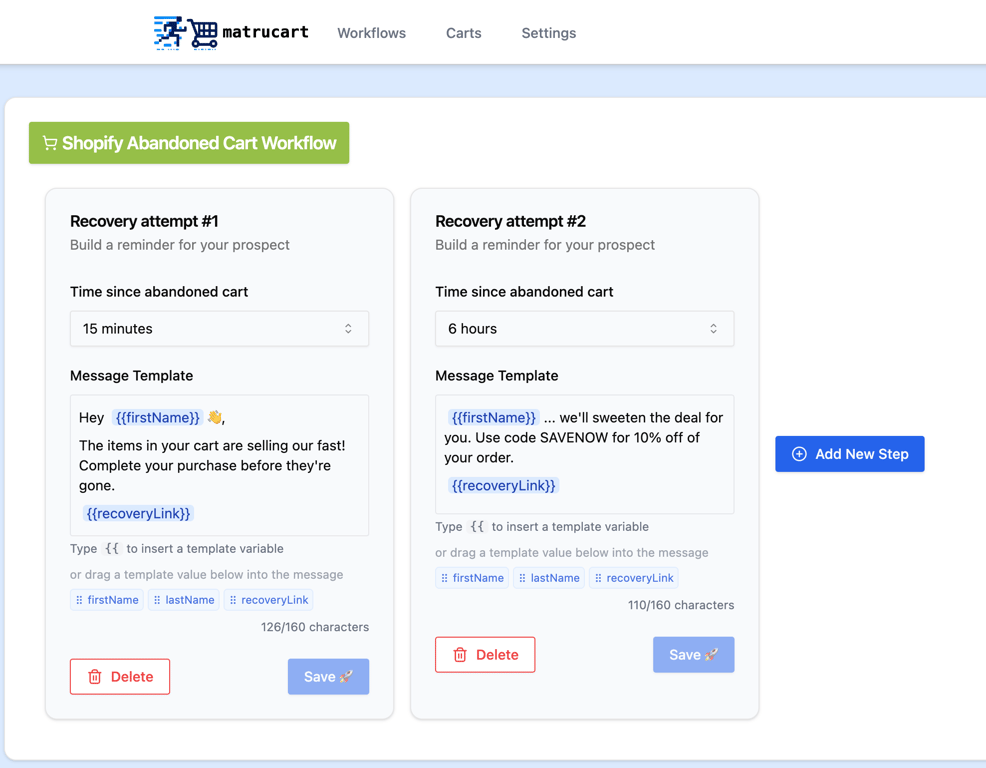
Touch 1: SMS at 30 minutes. Short, friendly, no discount yet. Just a reminder that the cart is still there. This catches the impulse-buy abandoners and the "I got distracted" abandoners. Expect to recover 12 to 18 percent of carts on this message alone.
Touch 2: Email at 24 hours. A longer message with product images, social proof (reviews, ratings), and maybe a small incentive (free shipping, 5 percent off). This catches the "I was researching" abandoners who needed time to think. Adds another 3 to 5 percent on top of the SMS recovery.
Touch 3: Email or SMS at 72 hours, with a stronger offer. The last call. A real discount (10 to 15 percent), a deadline, and a clear "this is your last chance" frame. Adds another 1 to 3 percent.
Total recovery rate from this sequence typically lands between 18 and 28 percent of abandoned carts, compared to 5 percent or less from the default Shopify email alone.
A few rules to make this work:
Stop the sequence the moment they buy. Nothing kills trust faster than getting a discount text after you already paid full price.
Keep the SMS short. 160 characters or fewer. One link.
Put the discount in the email, not the SMS. SMS is for urgency and reminder. Email is where deals live. (You can break this rule on high-value carts, but as a default, follow it.)
Send SMS during business hours in the customer's timezone. A 2am cart recovery text is the fastest way to get unsubscribes.
So Which Should You Set Up First?
If you're starting from zero, set up SMS first. It does more work, faster, and the setup is genuinely simpler than building a multi-email sequence with templates and design assets. If you're in the United States, you must also go through phone number verification, so might as well spin up that process while you can.
Matrucart handles SMS cart recovery for Shopify stores with no commission on recovered sales, flat transparent pricing, an affordable entry plan and a 30-minute send window built in by default. You can connect your store in two clicks and have your first recovery message live the same day.
Once SMS is running and recovering carts, layer email on top using Shopify's free built-in flow or a tool like Klaviyo. The combination is what gets you above 20 percent recovery. Either channel alone caps out well below that.
15 Abandoned Cart SMS Templates That Actually Recover Sales
15 ready to use sms templates you can use to start recovering sales for your abandoned carts in Shopify.
Read Full Story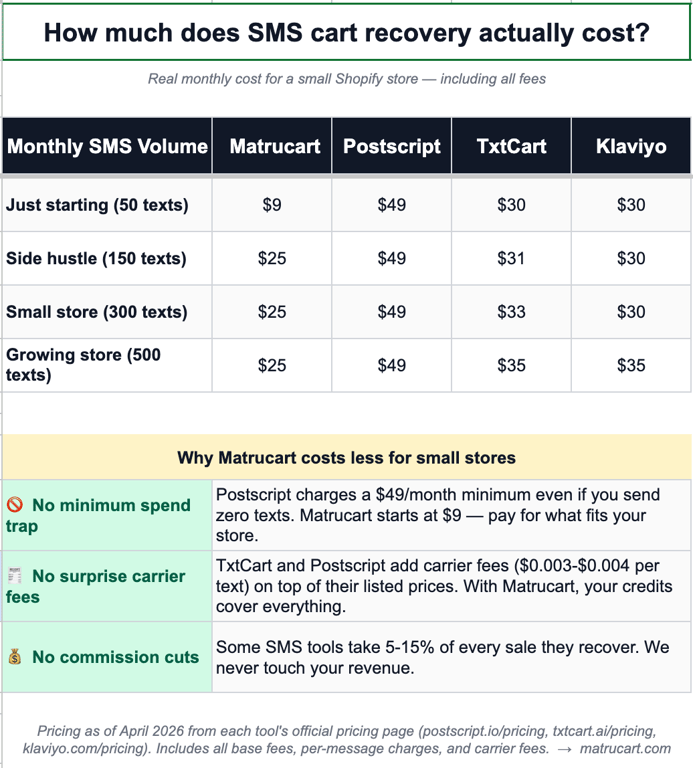
Best Affordable Abandoned Cart Apps for Shopify Stores doing less than $50K in revenue.
Are you just starting off your brand? What really is the best abandoned cart recovery tool to use for your Shopify store?
Read Full Story
👻 Don't Let Abandoned Carts Haunt Your Store This Halloween: Recover Sales with SMS Reminders
This Halloween, don't let abandoned carts haunt your store. Consider strategies to re-engage with shoppers via SMS!
Read Full Story